
Semi-solid-state power banks: safer and more durable?
August 13, 2026
Why semi-solid state power banks can be a better choice
A power bank is in your bag, on your desk, in the car and sometimes travels halfway around the world.
We expect such a compact battery to store thousands of milliampere hours of energy, charge our phone quickly and do one thing above all: function smoothly.
That is why it is not only the capacity that is important with power banks. The technology of the battery cell itself deserves at least as much attention.
An interesting development is the semi-solid state battery. This technology represents an intermediate step between the traditional lithium-ion or lithium-polymer battery with liquid electrolyte and the future fully solid-state battery.
But what exactly does that mean? And is a semi-solid-state power bank really a better choice?
First: what's actually in a regular power bank?
Most power banks use lithium-ion or lithium polymer cells.
In such a battery, lithium ions move between the positive and negative electrode. The electrolyte plays an essential role in this: it makes the transport of the ions possible.
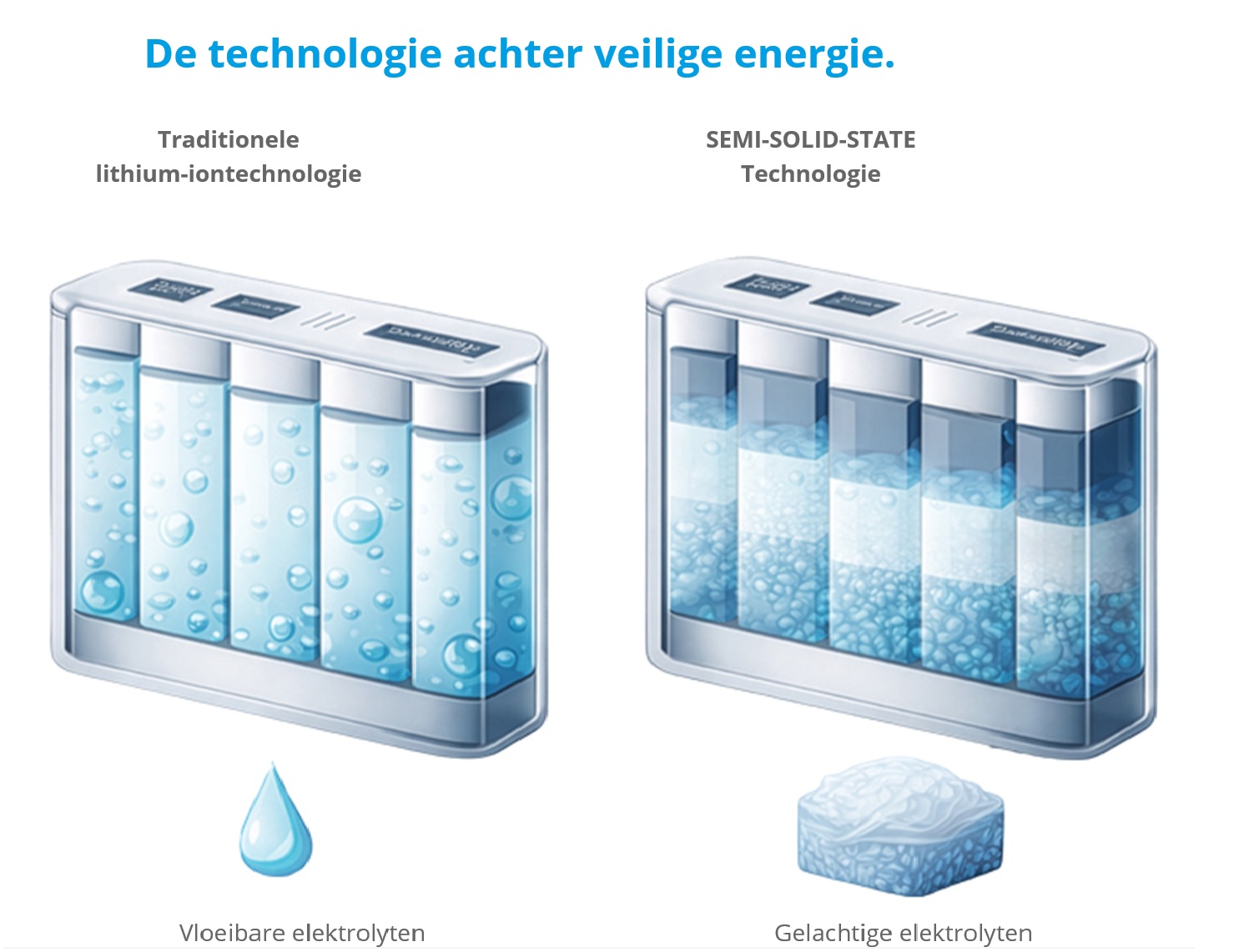
Traditional lithium batteries often use a liquid electrolyte for this.
This works excellently and has ensured that compact devices can now store relatively large amounts of energy.
However, a liquid electrolyte also has disadvantages. A lithium battery can become unstable if damaged, manufacturing errors, internal short circuit or extreme temperatures.
That is why good power banks contain various electronic protections against, for example, short circuit, overvoltage, overcharging and overheating.
What is semi-solid state?
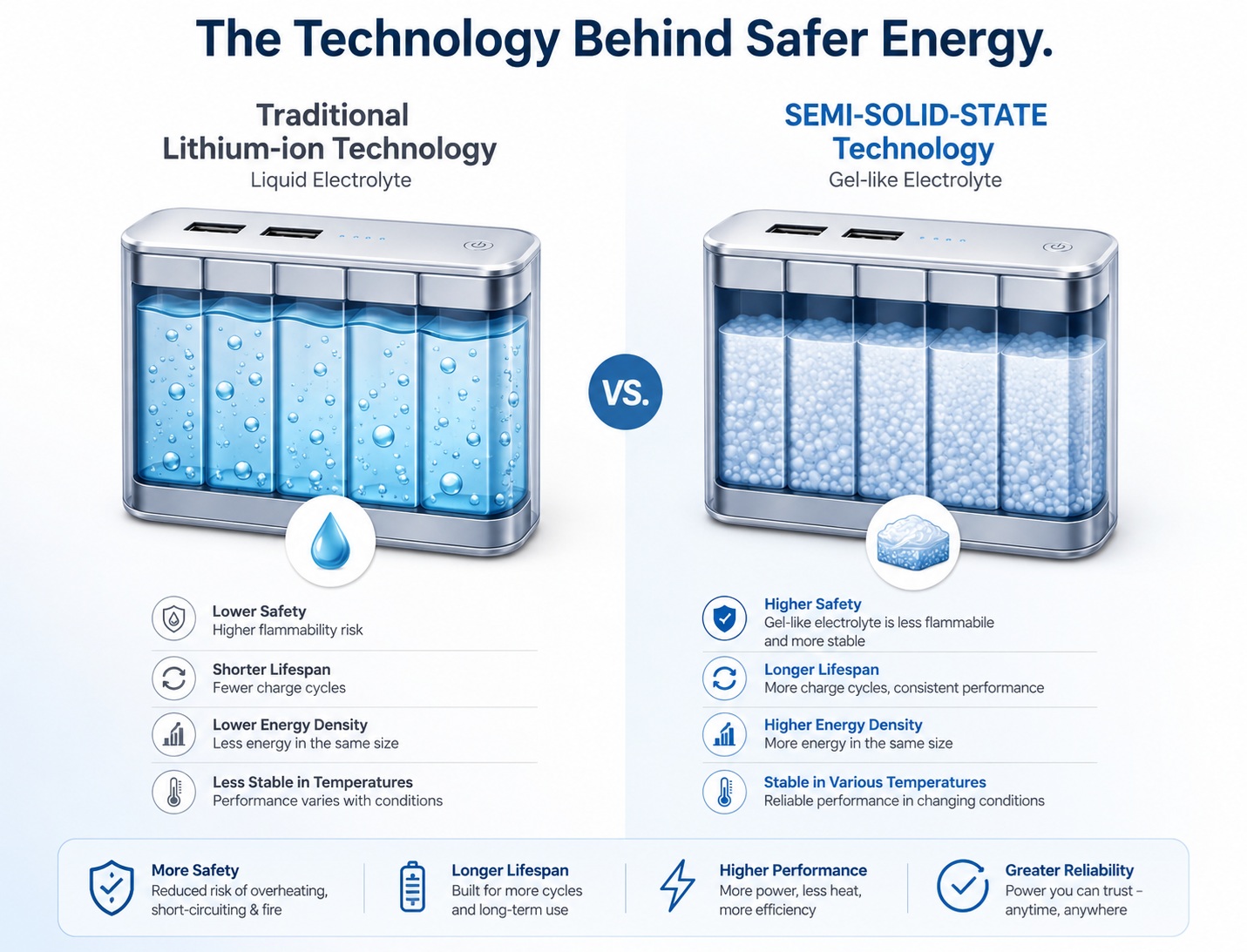
At one semi-solid state battery the liquid electrolyte is partially replaced or captured in a gel-like or polymeric structure.
You can see it as a technology between liquid and completely solid.
The electrolyte is therefore not simply a freely moving liquid as in many conventional battery constructions, but has more structure.
That sounds like a small technical difference.
However, it is particularly interesting for the development of batteries.
1. Safety is an important advantage
One of the main reasons for developing semi-solid-state technology is safety.
A gel-like electrolyte is less likely to leak and, depending on its exact chemical composition, may be less flammable than a conventional liquid electrolyte.
The structure also offers more mechanical stability.
That doesn't mean a semi-solid state battery can't overheat or become damaged. It remains a battery that stores a lot of energy in a small surface area.
The potential safety benefit mainly lies in reducing certain risks.
And this is interesting for a product that is carried every day in a backpack, handbag or laptop bag.
2. Less heat generation can help the battery
Heat is an important factor in battery life and safety.
Every battery produces some heat during charging and discharging. The temperature can rise, especially with fast charging and high power.
Semi-solid-state technology has been developed in part to improve the internal stability and thermal management of battery cells.
A more stable temperature management can benefit both the performance and the lifespan of a battery.
This is becoming increasingly relevant now that modern power banks can deliver, for example, 20 W, 65 W or even more power via USB-C Power Delivery.
3. A longer lifespan might be even more interesting
For a power bank it is not only important how much energy it can store today.
More interesting is:
How much capacity does it have left after hundreds of charging cycles?
Every battery ages. As a battery is charged and discharged more often, the maximum capacity slowly decreases.
New battery technologies such as semi-solid state aim, among other things, at a more stable cell structure and better performance over a larger number of charging cycles.
However, the exact lifespan varies per battery cell. It would therefore be too simplistic to say that every semi-solid-state power bank automatically lasts a certain number of years or charging cycles longer.
But a longer usable lifespan is an important development goal of this technology.
4. More energy in a compact housing
Another interesting concept is energy density.
Simply put, this indicates how much energy can be stored in a certain weight or volume.
Higher energy density can enable manufacturers to:
- fit more capacity in the same size;
- achieve the same capacity in a smaller housing;
- or limit the weight of a battery.
This is particularly relevant for a power bank.
After all, no one wants to take a heavy brick with them just to charge their phone one more time.
Semi-solid-state technology is therefore also being researched and developed as a route to batteries with a higher energy density.
5. Semi-solid-state is not a completely solid-state battery
This distinction is important.
The terms are easily used interchangeably in marketing.
One completely solid-state battery uses a solid electrolyte.
One semi-solid state battery still contains a liquid or gel-like component.
Semi-solid-state combines properties of existing lithium batteries with properties that we associate with solid-state technology.
So it's better to think of semi-solid state as one intermediate step in the development of battery technology then as a completely solid-state battery.
Is a semi-solid-state power bank automatically better?
Not by definition.
The battery cell is only one part of a good power bank.
At least as important are:
- the quality of the cells used;
- Battery Management System (BMS);
- short circuit protection;
- overvoltage protection;
- protection against overcharging;
- temperature protection;
- quality of the electronics;
- USB-C Power Delivery;
- product certification and safety testing performed.
A cheap power bank does not suddenly become a premium product because it contains a semi-solid-state cell.
The total construction ultimately determines quality and safety.
Why is this interesting for promotional gifts?
A power bank has been a popular promotional gift for years.
But something is changing.
Almost everyone now has a power bank somewhere. Just handing out a simple power bank is therefore not always distinctive.
This makes quality more important.
A modern power bank with, for example:
- semi-solid state battery technology;
- USB-C;
- Power Delivery;
- fast charging;
- good safety features;
- long service life;
actually has a story.
You are not just giving away a battery with your logo, but a product that has consciously taken into account technology, safety and lifespan.
This can make a significant difference for employees who are regularly on the road or business associates who travel a lot.
From 5,000 to 10,000 mAh
Capacity also remains important with semi-solid-state power banks.
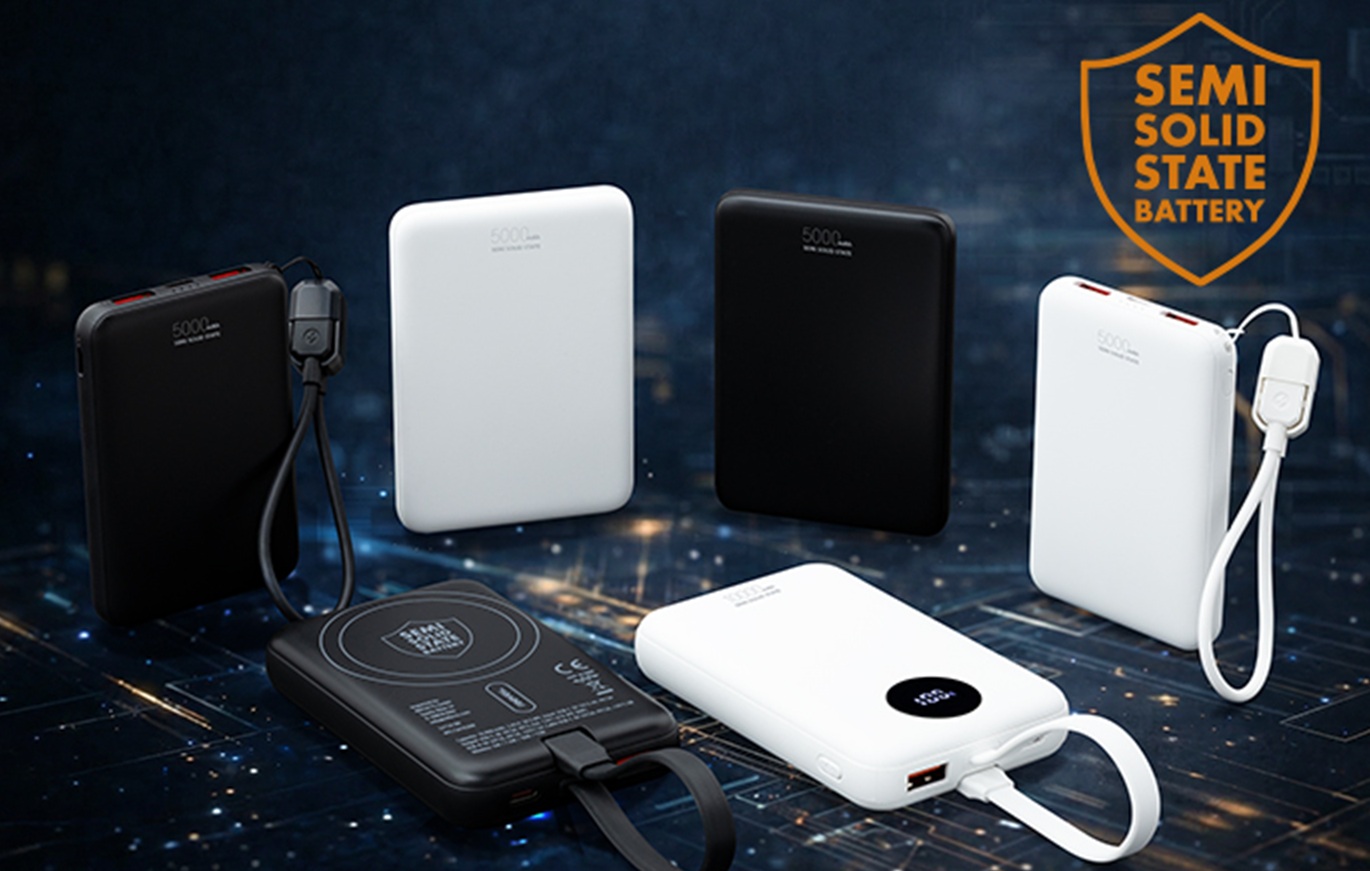
A compact one 5,000 mAh power bank is interesting for daily use and short trips. It is relatively small and easy to carry.
One 10,000 mAh power bank offers more reserves and is therefore attractive for employees who travel regularly or use their smartphones intensively.
In addition, modern features are interesting, such as:
- 20W USB-C Power Delivery;
- integrated USB-C cable;
- magnetic wireless charging;
- charge level indicator;
- charge multiple devices at the same time.
Battery technology is therefore important, but ultimately the complete product must match the use.
The next generation of power banks?
Semi-solid-state technology is not a panacea, nor is it a guarantee that every power bank is automatically safer, more powerful and more durable.
But the development is interesting.
By partially replacing liquid electrolytes or encapsulating them in a gel or polymer structure, manufacturers are attempting to reduce some of the known limitations of traditional lithium batteries.
This can provide advantages in terms of safety, stability, energy density and lifespan.
This is a logical development for power banks.
Because now that capacity and fast charging have almost become standard, attention is increasingly shifting to another question:
What is actually inside the power bank?
And that is precisely where semi-solid-state technology can be an important next step.
Looking for a semi-solid-state power bank with logo?
Would you like to have a modern power bank printed with your logo? View our range power banks with logo or contact us for personal advice. We are happy to help you choose the right capacity, charging technology and version for your target group and budget.
Tel: 030 2600 400 | 020 2600 100
Email: info@tigerconcept.nl
➡️ View all [power banks with logo]
Images
Frequently asked questions
A semi-solid-state power bank uses battery cells in which the electrolyte is partially captured in a gel-like or polymeric structure. It is an intermediate form between traditional liquid electrolytes and fully solid-state battery technology.
Semi-solid-state technology can provide certain safety benefits, such as reduced risk of leakage and better thermal and mechanical stability. However, the ultimate safety also depends on the quality of the battery cell, electronics, protections and construction of the power bank.
No. In a completely solid-state battery, the electrolyte is solid. A semi-solid-state battery still contains a liquid or gel-like component and is technically an intermediate form.
The technology offers opportunities for better cyclic stability and longer service life. However, how much longer a specific power bank lasts depends on the cell used, charging technology, temperature and use.